Home » Cuisine Guides »
Thai Cuisine
Thai cuisine is an executive masterclass in sensory equilibrium, defined by the volatile yet harmonious intersection of the ‘Five Pillars of Flavor’: Sweet, Sour, Spicy, Salty, and Bitter. This culinary identity functions as a sovereign cultural export, utilizing aromatic complexity and high-heat precision to command global palate authority. It is not merely a meal; it is a strategic orchestration of herbal chemistry and tactile dynamics.
Popular Recipes
-
⭐
4.9
|
30
min
Pad Thai (Stir-Fried Rice Noodles)
-
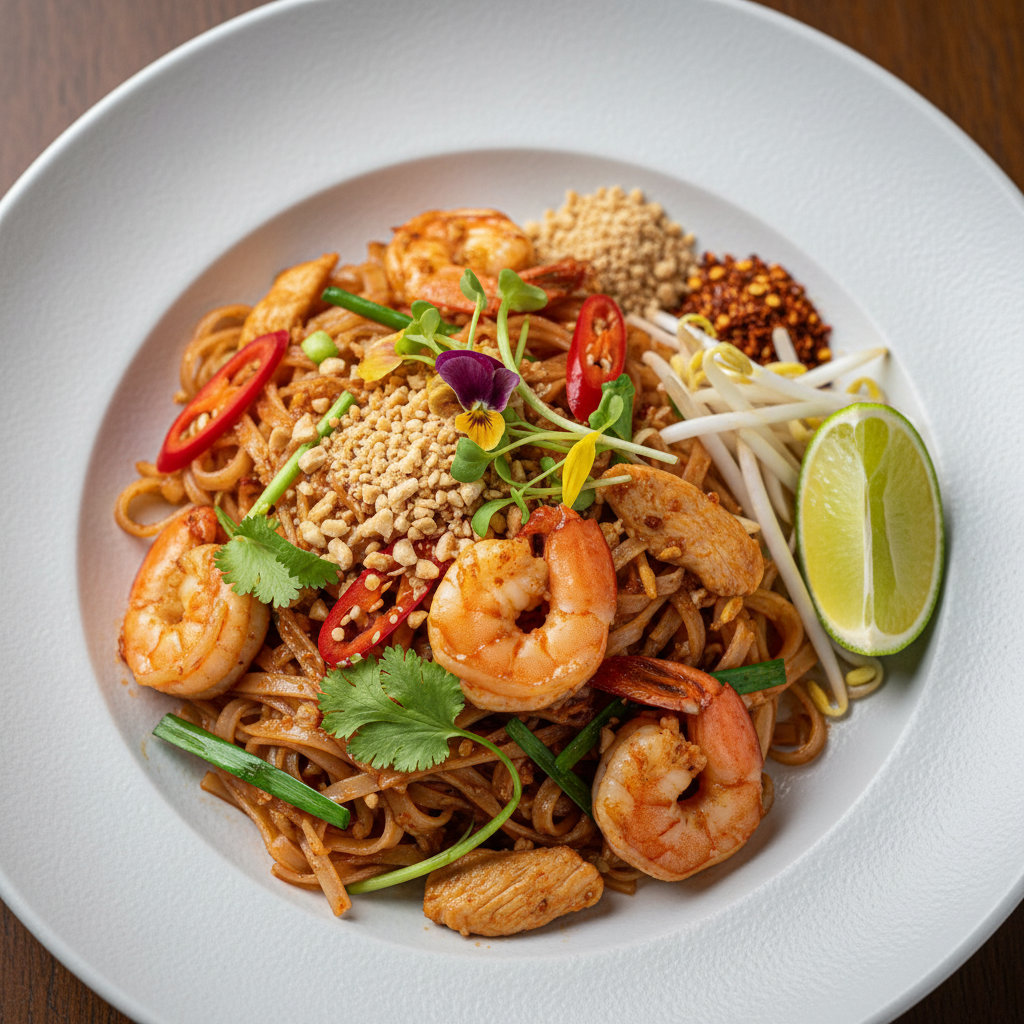
⭐
4.9
|
30
min
Pad Thai (Stir-Fried Rice Noodles)
-
⭐
4.9
|
40
min
Mango Sticky Rice (Khao Niew Mamuang)
-
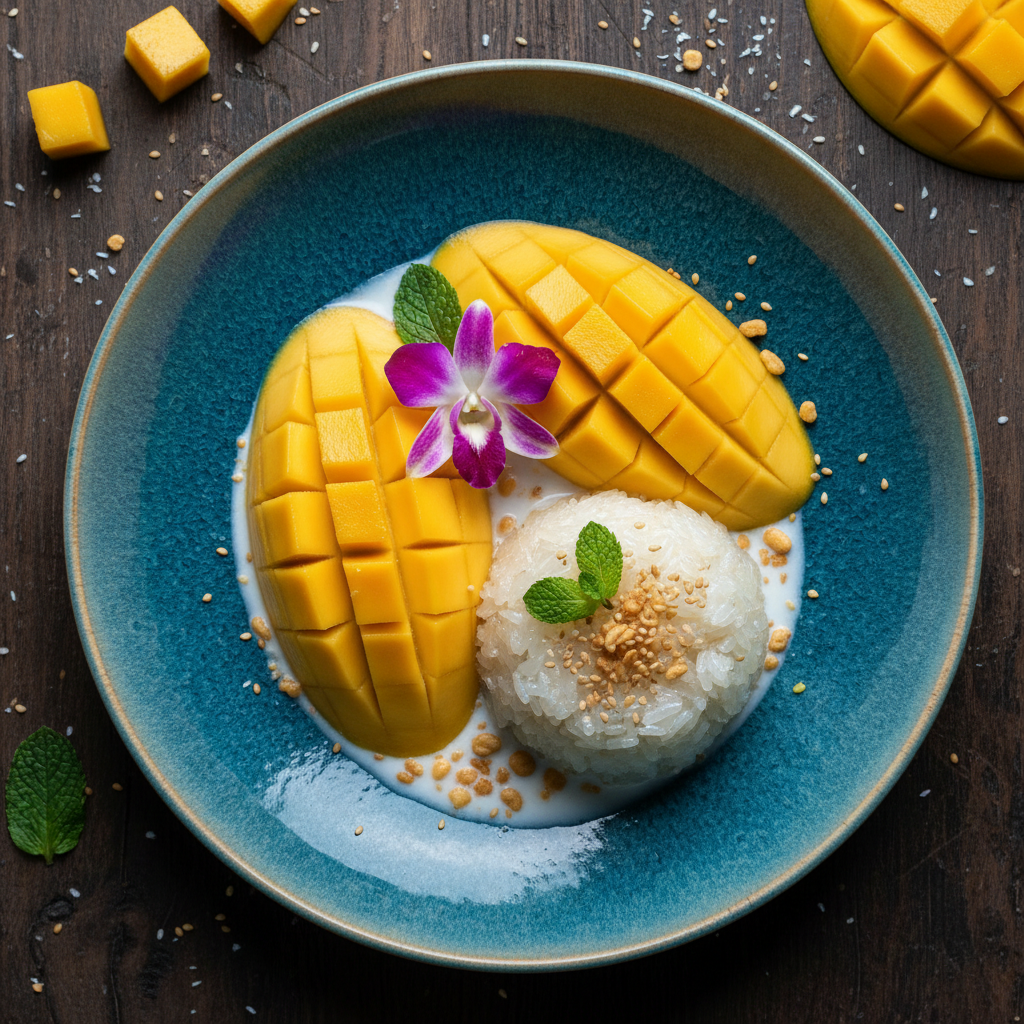
⭐
4.9
|
40
min
Mango Sticky Rice (Khao Niew Mamuang)
The flavor jurisdiction of Thailand is codified by its geography as a maritime crossroads. The evolution of the ‘Siam Palate’ was influenced by the $17^{th}$-century introduction of the chili pepper by Portuguese traders and the adaptation of Chinese wok techniques. The foundational laws of Thai taste are governed by the lush central plains, the mountainous Lanna north, and the spice-heavy southern peninsula.
**Central:** The seat of Royal Cuisine, emphasizing refinement and coconut-based richness. **Isan (Northeast):** A rugged jurisdiction focused on fermentation, dry heat, and bold acidity. **North:** A cooler climate favoring herbal bitterness and pork-centric fats. **South:** A high-intensity region defined by turmeric, sea-salt, and extreme Scoville concentrations.
The ‘Flavor Constitution’ requires strict adherence to indigenous aromatics. Essential statutes include: **Galangal** for earthy citrus notes, **Lemongrass** for bright acidity, and **Fermented Fish Sauce (Nam Pla)** as the primary source of umami-based salinity. **Chef Insight:** Precision in slicing kaffir lime leaves to less than $1mm$ is mandatory to release oils without introducing structural interference. **Mom Insight:** Never substitute lemon for lime; the soul of the dish depends on that specific green brightness.
The constitutional balance mandates that no single flavor dominates the profile. A standard audit of a Green Curry requires a $40%$ Creamy/Salty base, $30%$ Spicy kick, $20%$ Herbal bitterness, and $10%$ Sweet finish.
The perfect Thai bite is an engineering feat of three layers: **Crunch (Resistance)** provided by raw vegetables or crushed peanuts; **Tenderness (Yield)** found in proteins cooked to exactly $63°C$; and **Silk (Emulsion)** delivered by coconut fats or reduced sauces. **Chef Insight:** The Maillard reaction on a shrimp must be instantaneous to preserve the internal moisture at $85%$. **Mom Insight:** The bite must always include a small portion of rice to act as the flavor absorbent.
Tactile engineering in Thai cuisine focuses on the ‘Jaw-Feel.’ Sticky rice requires a specific $24$-hour soak to achieve a $15%$ elasticity rate, ensuring the grain resists the teeth before yielding to the tongue.
The Thai lexicon for mouthfeel is distinct: **Krop** (Maximum crispness/shatter), **Niao** (The specific ‘pull’ of glutinous rice), **Mun** (The rich, velvet-like coating of coconut cream), and **Saep** (The vibrating heat sensation on the tongue).
Technical precision involves the ‘Two-Stage Extraction’ method for curry pastes. **Stage 1:** Dry-pounding fibrous aromatics. **Stage 2:** Wet-emulsifying shrimp paste and shallots. **Chef Insight:** Wok-hei (Breath of the Wok) is achieved by maintaining a surface temperature of at least $250°C$.
Thai flavor logic is a dynamic equilibrium where sour, sweet, salty, spicy, and bitter notes exist in a high-tension tug-of-war. Unlike Western culinary traditions that seek a singular, blended sauce, Thai chefs prioritize ‘Layered Aromatics’ where ingredients are bruised to release volatile oils rather than finely minced, ensuring each bite delivers a rotating sensory experience.
The **Krok** (Granite Mortar and Pestle) is the essential hardware for Isan and Central sauces, while the **Kratha** (Carbon Steel Wok) governs the stir-fry protocols of the street-side masters.
The Digital Hub categorizes assets based on technical difficulty and cultural significance. These recipes represent the ‘Gold Standard’ of Thai culinary documentation.
**Foundation:** Authentic Jasmine Rice, Basic Red Curry Paste. **Masterclass:** Blue Swimmer Crab Curry with Betel Leaves, Royal Tom Yum Goong ($100°C$ broth infusion). **Home Soul:** Pad Krapow (Holy Basil Stir-fry), Som Tum (Green Papaya Salad).
Thai etiquette follows a ‘Lateral Service’ protocol. Meals are served family-style to ensure flavor diversity. The primary tool is the spoon (held in the right hand), with the fork (left hand) acting only as a pusher. To use a fork to put food into the mouth is a breach of high-court protocol.
The Spoon and Fork Rule: In Thailand, the spoon is your primary tool. The fork is used solely to push food onto the spoon. It is considered a breach of etiquette to place the fork directly into your mouth. Furthermore, sharing is the ultimate sign of respect; never order a single dish for yourself in a communal setting.
Service begins with **Khong Wang** (Appetizers), followed by a simultaneous presentation of **Tom** (Soup), **Kaeng** (Curry), and **Khruang Kiang** (Side Dishes), all anchored by the central rice vessel.
More Recipes from this Cuisine
-
⭐
4.8
|
25
min
Tom Yum Goong (Spicy Shrimp Soup)
-
⭐
4.9
|
30
min
Pad Thai (Stir-Fried Rice Noodles)
-
⭐
4.7
|
35
min
Green Curry (Gaeng Keow Wan)
-
⭐
4.6
|
20
min
Som Tum (Green Papaya Salad)
-
⭐
4.8
|
115
min
Massaman Curry (Gaeng Massaman)
-
⭐
4.5
|
40
min
Tom Kha Gai (Coconut Chicken Soup)