Home » Cuisine Guides »
Indian Cuisine
The Subcontinental Mandate: A Symphony of Spice and Soul. Indian cuisine exists as a living archive of a five-thousand-year civilization, where food is not merely sustenance but a spiritual and medicinal contract. It represents a complex architecture of flavors built on the bedrock of **Ayurveda** and the relentless pursuit of **Rasa** (the essence of taste).
Popular Recipes
-
⭐
4.8
|
60
min
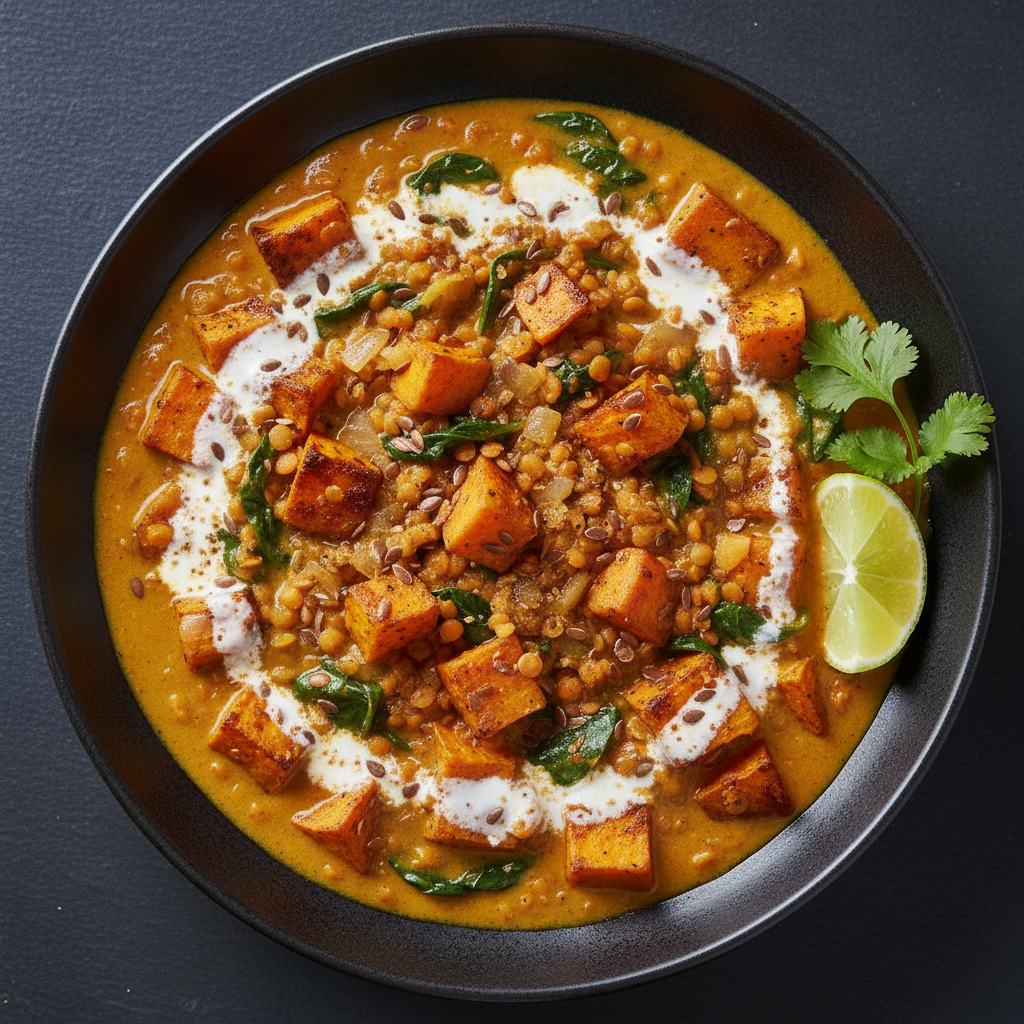
Slow-Cooked Lentil & Sweet Potato Curry
The geography of Bharat serves as the ultimate legislative body for its flavors. From the Himalayan peaks to the tropical tip of Kanyakumari, the land dictates the fat (mustard oil, ghee, coconut oil) and the grain. The Silk Road and Mughal conquests introduced the slow-cooking **Dum** technique and dried fruits, while the colonial era brought the ‘New World’ essentials like chilies and potatoes, now inseparable from the national identity.
• **The Northern Heartland:** Focuses on dairy-rich gravies and tandoor-fired breads. • **The Southern Peninsula:** Characterized by fermented batters, tamarind acidity, and coconut foundations. • **The Eastern Delta:** Celebrates the delicate balance of freshwater fish and **Panch Phoron** (five-spice). • **The Western Frontier:** A showcase of parched-land preservation and vibrant vegetarianism.
The legal framework of the Indian kitchen is the **Masala Dabba** (spice box). Authenticity is governed by the **Tadka** or **Chhonk**—the process of tempering whole spices in fat to unlock lipid-soluble aromatic compounds. It is a precise thermal extraction of flavor.
**The 3-Star Michelin Chef Insight:** ‘Technical precision in Indian cuisine relies on the caramelization of Alliums at exactly $160°C$ and the sequential layering of spices. If the turmeric hits the oil too early, it burns; too late, it remains raw. It is a game of seconds.’ **The Home Cook Mom Insight:** ‘Measurements are for the unsure. One cooks with the eyes and the nose. If the aroma doesn’t fill the street, the spices aren’t awakened.’
The Indian Perfect Bite is a triadic equilibrium. **Resistance (Crunch):** Provided by papadums or the crisp crust of a Dosa. **Yield (Tenderness):** Found in the melt-in-mouth texture of a Galouti kebab. **Emulsion (Silk):** The velvety consistency of a $24$-hour slow-cooked Dal Makhani.
Interaction with Indian food is inherently manual. The fingers act as thermal sensors and mixing tools. The Jaw-Feel is designed for the tearing of gluten-developed breads (Naan) and the effortless crush of long-grain Basmati rice, where each grain must remain distinct yet tender.
Key native descriptors include: **Khurkhura** (brittle-crunchy), **Naram** (soft-yield), **Chatpata** (piquant-tangy-spicy synergy), and **Malai** (cream-like silkiness).
The Standard Operating Procedure involves **Bhuna** (the intensive frying of spices and aromatics until the oil separates) and **Dum** (trapping steam to allow internal pressure to tenderize fibers). Accuracy in heat management is non-negotiable.
Indian flavor logic is centered on the concept of Rasas and the sequential layering of spices to achieve a high-contrast sensory profile. Unlike the Western focus on homogenization or the Eastern focus on subtle umami, Indian cooking relies on ‘blooming’ or tempering (Tarka) to release fat-soluble essential oils, creating a multi-dimensional foundation where heat, acidity, and earthiness are balanced through specific chemical transitions during the cooking process.
The **Tandoor** (clay oven), the **Karahi** (heavy-bottomed wok), and the **Sil Batta** (grinding stone) are the foundational instruments required for tectonic flavor shifts.
• **Foundation:** Jeera Rice, Basic Tadka Dal, Roti. • **Masterclass:** Awadhi Biryani, Butter Chicken (from scratch), South Indian Sambhar. • **Home Soul:** Khichdi, Masala Chai, Aloo Paratha.
Recipes are integrated through the UCCF Data Model, ensuring each step follows the thermal and sequence protocols established by the regional heritage.
Hosting is an act of **Atithi Devo Bhava** (The Guest is God). Service must be abundant. The meal starts with appetizers, followed by the **Thali** or main course served simultaneously to ensure every flavor profile is accessible at once.
In Indian culture, the concept of ‘Atithi Devo Bhava’ dictates that a guest is a manifestation of the divine. Always eat and pass communal dishes with your right hand, as the left is traditionally reserved for hygiene. It is considered a gesture of deep respect to accept the first offering of bread (Roti) and to leave no food on the plate, honoring the labor of the chef and the sanctity of the ingredients.
1. Aperitifs/Starters. 2. The Main Spread (Carbohydrate, Protein, Vegetable, Lentil, Pickle, Yogurt). ” 3. The Palate Cleanser (Mukhwas). ” 4. The Dessert (Mithai).
More Recipes from this Cuisine
-
⭐
4.8
|
60
min
Slow-Cooked Lentil & Sweet Potato Curry