Home » Cuisine Guides »
Korean Cuisine
Korean cuisine, or **Hansik**, represents a sovereign culinary jurisdiction where time is the primary architect. This system is governed by the philosophical mandate of **Yakhyeon-shik-won**—the legal principle that medicine and food share the same origin. The table serves as a diplomatic accord between the five cardinal elements, emphasizing harmony over individual dominance. Authority is derived from the **Trinity of Fermentation**, establishing a flavor profile that is both ancient and scientifically precise.
Popular Recipes
-
⭐
4.9
|
55+120
min
Marinated Beef BBQ
-
⭐
4.9
|
80
min
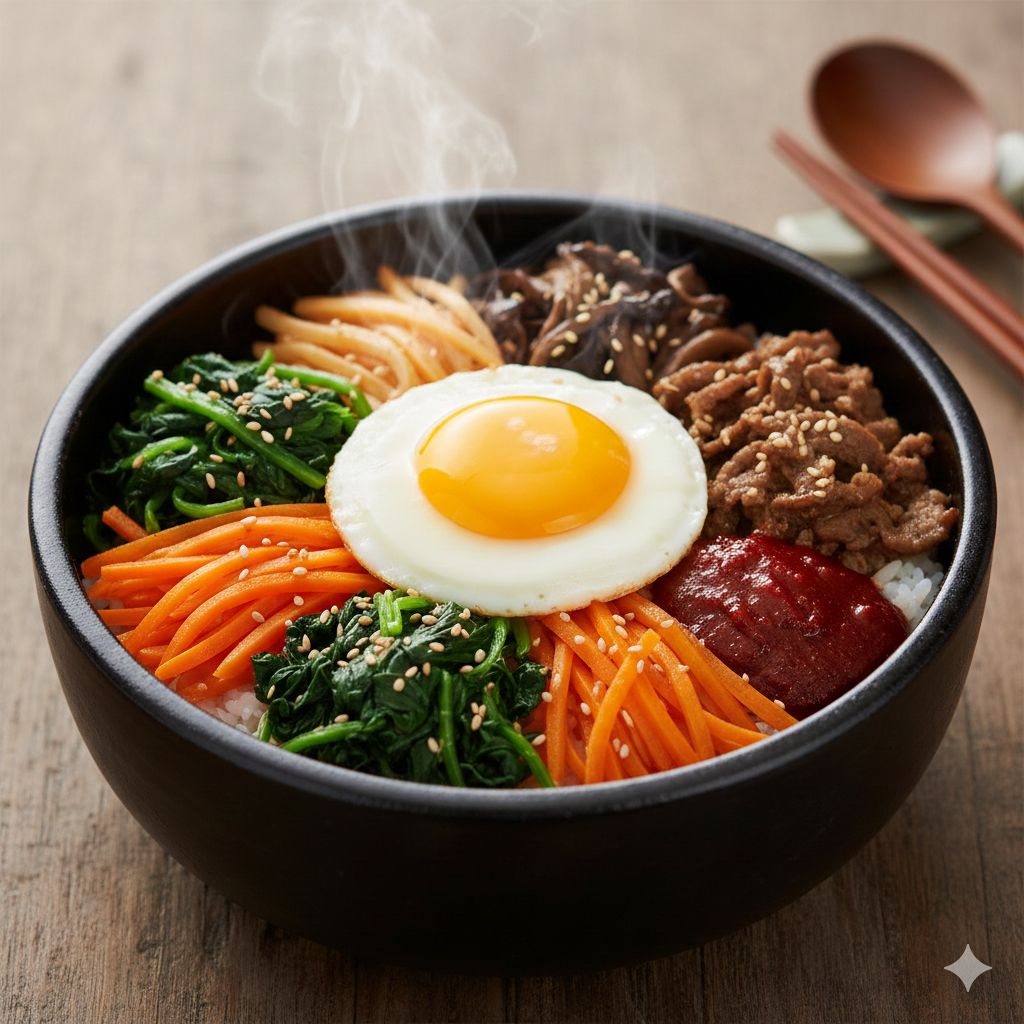
Mixed Rice Bowl
-
⭐
4.9
|
55+120
min
Marinated Beef BBQ
-
⭐
4.9
|
45+240
min
Marinated Short Ribs
The Korean peninsula’s geography acts as the founding ‘Flavor Law.’ With a landscape that is $70%$ mountainous, the historical jurisdiction mandated a culture of **preservation and gathering**. The Joseon Dynasty codified these practices into **Royal Court Cuisine**, a high-etiquette standard that balanced regional tributes. Geography dictated that the north favored mild, less salty profiles, while the southern provinces utilized heavy salting and fermentation to combat higher temperatures.
Provincial boundaries define the palate: **Jeolla-do** remains the ‘Flavor Capital’ known for opulent variety; **Gyeongsang-do** emphasizes the raw heat of peppers; and **Jeju Island** provides a distinct maritime jurisdiction focusing on sea-harvested proteins and volcanic soil grains.
The ‘Flavor Constitution’ is anchored by the **Jang** system. No dish possesses sovereign authority without the presence of fermented soy products. **3-Star Michelin Chef Insight**: The technical precision of Hansik lies in the **microbial management** of Ganjang (soy sauce), Doenjang (soybean paste), and Gochujang (chili paste). These are the ‘Legislative Pillars’ of flavor. **Home Cook Mom Insight**: Authenticity is not measured in grams, but in **Sohn-mat** (hand-taste)—the intuitive heat and pressure applied when seasoning greens by hand.
The aesthetic constitution requires the presence of **Obangsaek** (Five Colors): Green, Red, Yellow, White, and Black. This is not merely visual; it is a regulatory requirement for nutritional completeness and elemental balance.
The Anatomy of the Perfect Korean Bite is a triadic audit of **Crunch (Resistance), Tenderness (Yield), and Silk (Emulsion)**. The resistance of a $4°C$ aged kimchi provides the ‘crunch’ that must be countered by the ‘yield’ of short-grain rice and the ‘silk’ of a high-collagen bone broth.
The use of **Sujeo** (stainless steel spoon and chopsticks) is a mandatory engineering requirement. Metal chopsticks provide a high-resistance shearing force, allowing the diner to navigate fermented fibers with surgical precision. The spoon, meanwhile, is the primary vehicle for the ‘Liquid Foundation’ (soup), ensuring a high-volume delivery of temperature-stable umami.
Global terminology is expanded by **Jjol-git-han**, describing the elastic, bouncy resistance found in rice cakes, and **Kkal-kkeum-han**, denoting a sharp, clean finish that resets the palate between bites of pungent fermented pastes.
Technical precision requires strict **Thermal Management**. Maillard reactions on Bulgogi must be achieved at $200°C$ for carbonized depth, while Kimchi must be matured at a stable $2°C$ to $5°C$ to ensure the proliferation of *Leuconostoc* bacteria over lactic acid over-producers.
Korean flavor logic is governed by ‘Yaksikdongwon’—the principle that food and medicine share the same origin. Unlike Western cuisines that rely on fat-based emulsification or French-style reductions, Korean masters utilize ‘Jang’ (fermentation) to build layers of deep umami. Texture is equally prioritized through ‘Ssam’ (wrapping) and ‘Banchan’ (side dishes), ensuring a balance of crunchy, soft, and fermented elements in every bite to promote digestive harmony and sensory complexity.
The **Dolsot** (porous stone pot) is the essential tool for heat retention, ensuring the rice crust (Nurungji) reaches the required $120°C$ for optimal caramelization. The **Onggi** (earthenware jar) acts as the ‘Respiratory Vessel’ for fermentation.
Assets are categorized by their role in the culinary hierarchy: **Foundation** (The essential laws), **Masterclass** (High-court techniques), and **Home Soul** (Daily constitutional meals).
**Foundation**: Baechu Kimchi, Steamed Short-Grain Rice. **Masterclass**: Gujeolpan (Platter of Nine Delicacies), Galbi-jjim (Slow-Braised Short Ribs). **Home Soul**: Doenjang-jjigae (Soybean Paste Stew), Bibimbap, Japchae.
The protocol of the meal follows a strict hierarchy. The elder or highest-ranking official must lift their spoon first to signal the start of the ‘Legislative Session.’ Rice bowls are never lifted from the table—a stark contrast to neighboring jurisdictions—and the Sujeo must be returned to its rest position at the conclusion of the course.
In Korean culture, the concept of ‘Jeong’ (deep connection) dictates dining. A vital protocol for any guest is to never lift their rice or soup bowl off the table, as this is seen as impolite. Always wait for the eldest person to lift their spoon first, and when receiving a drink, hold your glass with two hands to show respect for the host’s generosity.
The **Bapsang** system features simultaneous service. Unlike Western sequential models, all components—the main protein, the soup, and the Banchan (side dishes)—arrive at once, allowing the diner to engineer their own flavor sequences.
More Recipes from this Cuisine
-
⭐
4.8
|
25
min
Spicy Cold Noodles
-
⭐
4.7
|
25
min
Kimchi Fried Rice
-
⭐
4.8
|
60
min
Korean Rice Rolls
-
⭐
4.7
|
35
min
Seafood Scallion Pancake
-
⭐
4.9
|
80
min
Mixed Rice Bowl
-
⭐
4.9
|
45+240
min
Marinated Short Ribs