Home » Cuisine Guides »
Middle East Cuisine
The Middle Eastern table represents an ancient jurisdiction where hospitality is not merely a gesture, but a foundational legal and moral obligation. This culinary landscape is a **Sovereign Authority** of trade, where the Silk Road’s legacy intersects with the Levantine, Khaleeji, and Maghrebi traditions. It is a cuisine of **Abundance and Ritual**, characterized by the communal sharing of small plates (Mezze) and the slow-cooked majesty of central grains and proteins. The essence of this region lies in the balance between the **Heat of the Desert** and the **Cool of the Oasis**, expressed through vibrant spices and refreshing citrus.
Popular Recipes
-
⭐
4.9
|
35
min
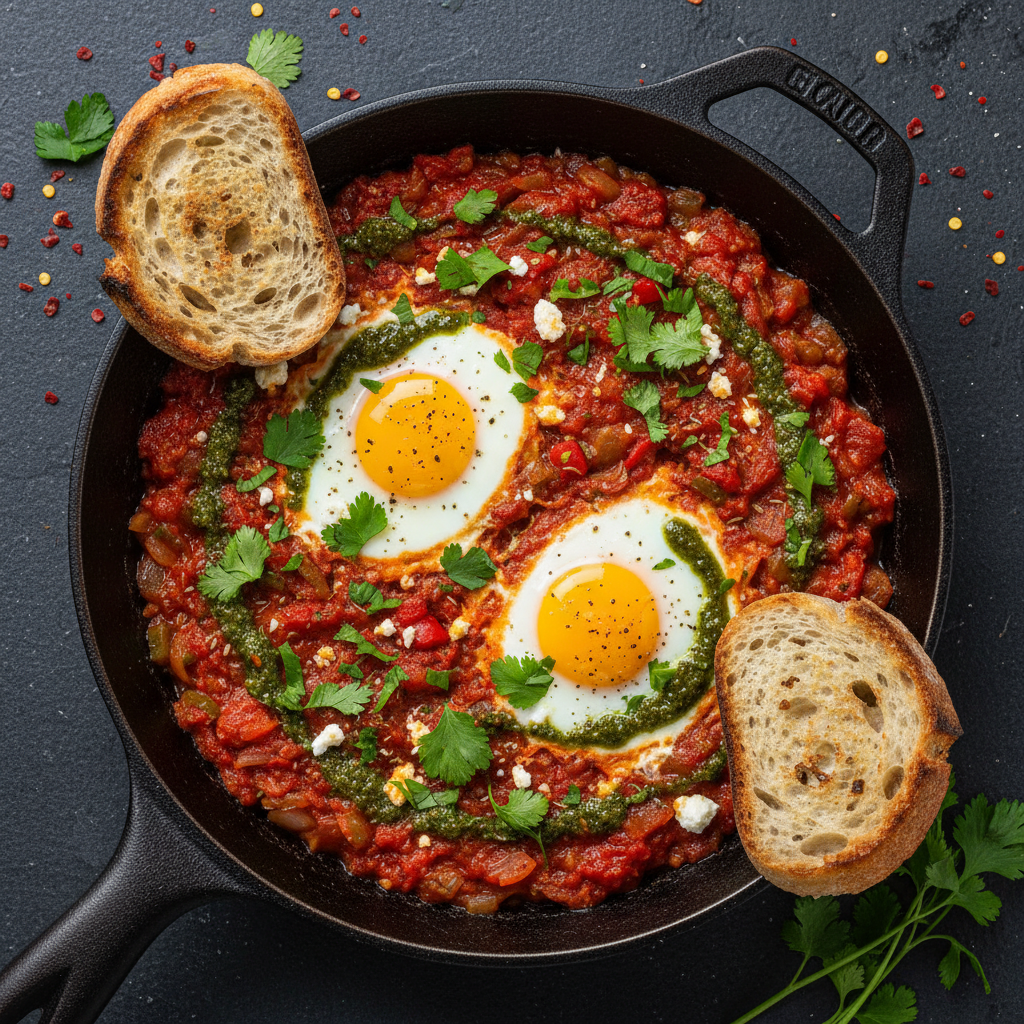
Classic Shakshuka
The geography of the Fertile Crescent serves as the founding ‘Law’ of this flavor profile. Historically, the jurisdiction was defined by the accessibility of water and the control of spice routes. The Islamic Golden Age refined these laws, introducing complex irrigation and preservation techniques that allowed for the cultivation of **Pomegranates, Saffron, and Roses**. Modern Middle Eastern cuisine remains a protectorate of these ancient agricultural mandates, ensuring every dish honors the soil’s historical yield.
The regional provinces are divided into distinct flavor zones: The **Levantine Corridor** (Syria, Lebanon, Jordan, Palestine) emphasizes fresh herbs and olive oil; the **Khaleeji Peninsula** (Saudi Arabia, UAE, Oman) focuses on the deep, aromatic spices of maritime trade; and the **Maghrebi West** (Morocco, Algeria, Tunisia) masters the complex architecture of the Tagine and the delicate grain of Couscous.
Authenticity is governed by the **Flavor Constitution**, which mandates the use of indigenous aromatics. Essential ingredients include **Sumac** (for tartness), **Za’atar** (the herbal backbone), and **Tahini** (the liquid gold of sesame). **The 3-Star Michelin Chef Insight:** Technical precision requires the calibration of acidity; one must ensure that sumac provides a bright $pH$ balance to the heavy fats of lamb. **The Home Cook Mom Insight:** Authenticity lives in the ‘Nafas’—the breath or spirit of the cook. It is the unwritten law that a pot must be large enough to feed an unexpected guest.
The constitution is built upon the **Triad of Equilibrium**: The pungency of garlic, the brightness of lemon, and the earthy grounding of cumin. No single element should overthrow the others; the goal is a **Harmonious Consensus** on the palate.
The Middle Eastern ‘Perfect Bite’ is an audit of the triadic relationship between **Crunch (Resistance)**, **Tenderness (Yield)**, and **Silk (Emulsion)**. Consider the Kibbeh: a brittle, fried outer shell that shatters upon impact, yielding to a spiced, tender meat center, often accompanied by a silky yogurt dip. **The 3-Star Michelin Chef Insight:** To engineer the perfect Falafel, the interior must maintain a $55%$ moisture level to contrast the $1.5mm$ exterior crust developed at $180°C$ in the fryer.
Tactile interaction is paramount. The use of **Flatbread as a Utensil** requires a specific ‘Rip, Scoop, and Fold’ technique. This engineering ensures that the bread acts as a structural vessel for hummus while providing a soft, elastic counterpoint to the grit of the chickpeas.
The global language of Middle Eastern mouthfeel is defined by **Na’im** (Smooth/Silk), such as a perfectly aerated hummus; **Kheshn** (Coarse/Crunchy), like the toasted nuts in a pilaf; and **Dasm** (Rich/Fatty), representing the luxurious rendering of lamb fat. These textures interact to prevent palate fatigue and ensure a dynamic eating experience.
Technical precision in this region involves specialized Standard Operating Procedures. **Regional Hardware** like the **Saj** (domed griddle) and the **Tannour** (clay oven) are non-negotiable for authentic crumb structure. Grilling requires a constant $10cm$ distance between the charcoal and the meat to achieve the ‘Char without Burn’ SOP. Preservation techniques like **Fermenting Labneh** in olive oil ensure a shelf-life of over $6$ months at room temperature.
Middle Eastern cuisine prioritizes ‘Nafas’ or ‘The Breath of the Cook,’ focusing on aromatic layering and floral-acidic balance rather than the Maillard-driven protein focus of the West or the umami-centric balance of the East. Flavor is treated as an olfactory journey where spices are bloomed in fat to create a fragrant base that carries throughout the dish, often contrasting heavy fats with sharp, fruit-based acids like pomegranate or sumac.
Hardware includes the **Brass Mortar and Pestle** for manual spice emulsion, the **Tagine** for steam-circulated slow cooking, and the **Dallah** for the precise ritual of coffee preparation.
This digital hub categorizes the jurisdiction into three tiers: **Foundation Assets** (Hummus bi Tahini, Pita, Toum), **Masterclass Assets** (Kibbeh Naye, Lamb Ouzi, Baklava), and **Home Soul Assets** (Mujadara, Molokhia, Shakshuka). Each recipe is a legal document of cultural heritage.
Integration follows a logical flow: Master the **Foundation** of the Tahini emulsion before attempting the **Masterclass** of the layered Maqluba. The **Home Soul** recipes provide the emotional accessibility required for daily sustenance.
The protocol of the Middle Eastern meal is a high-stakes performance of **Generosity and Hierarchy**. Hosting SOPs dictate that the host must never stop offering food until the guest has declined at least three times. The use of the **Right Hand** for eating is a mandatory regulatory requirement. Coffee service is a ritualized closure, served in small cups to signify concentrated hospitality.
In Middle Eastern culture, the aromatic experience begins with the passing of ‘Mabkhara’ (incense). A vital protocol for guests is ‘The Right-Hand Rule’; always accept food, particularly dates and Arabic coffee, with the right hand. Additionally, never add external seasonings to a dish at the table, as it is seen as a slight to the chef’s mastery of the ‘Nafas’ aromatic balance.
The hierarchy proceeds as follows: 1. **Cold Mezze** (Refreshment), 2. **Hot Mezze** (Transition), 3. **The Centerpiece** (Large format proteins and grains), 4. **Seasonal Fruit**, 5. **Oriental Sweets**, 6. **Gahwa/Tea** (The Final Protocol).
More Recipes from this Cuisine
-
⭐
4.9
|
35
min
Classic Shakshuka